
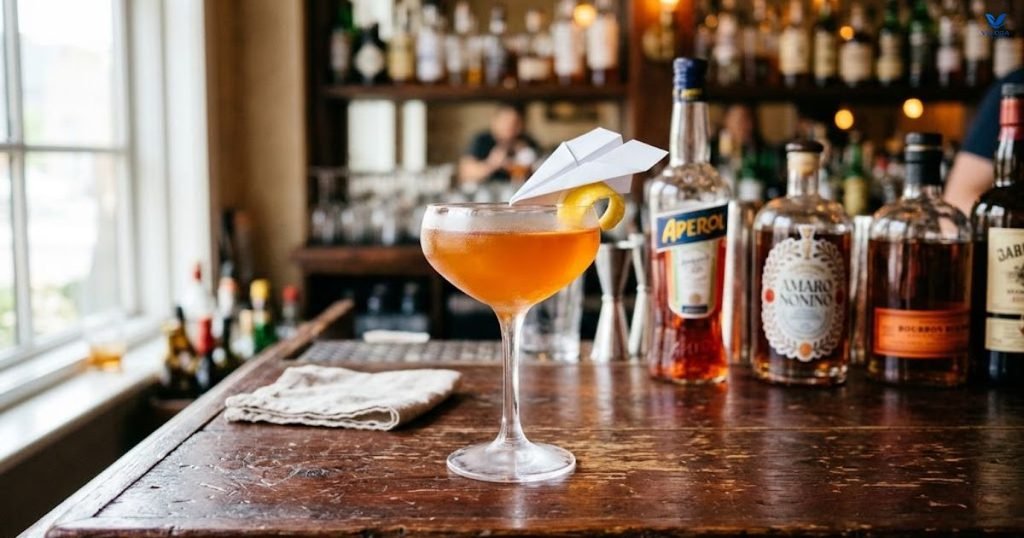
One of those few drinks in modern times that is simple to remember and difficult to mess up is the Paper Plane cocktail. It costs 4 ingredients, one ratio, and one shaker. The ingredients are boiled together in equal parts of bourbon, Aperol, Amaro Nonino, and fresh lemon juice, and the result is a bright amber-orange sour, which is simultaneously bitter, sweet, tart, and warming. If you are a whiskey lover of a whiskey sour and you want a little more personality, this is the next drink to learn.
Here you will find the exact Paper Plane drink recipe, a measurement chart for serving to a crowd, the tale of the cocktail’s creation, tips on the ingredients, clever alternatives, variations, cocktail pairing ideas, a non-alcoholic version, and answers to the most frequently asked questions. All content is for legal drinking age adults only; please drink responsibly!
Paper Plane Cocktail Recipe at a Glance
The short version prior to the deep dive. The classic style with a popular pour of three-quarters of an ounce is presented in Table 1. Alternatively, the official IBA spec specifies using 30 ml of each ingredient, and that is fine, as the drink is based on a ratio rather than volume.
| Detail | Classic Paper Plane |
|---|---|
| Base spirit | Bourbon whiskey |
| Ingredients | Bourbon, Aperol, Amaro Nonino, fresh lemon juice |
| Ratio | 1:1:1:1 (equal parts) |
| Common pour | 3/4 oz (about 22 ml) of each |
| IBA for | 30 ml of each |
| Method | Shake with ice, strain, and serve up. |
| Glass | Chilled coupe or cocktail glass |
| Garnish | Lemon or orange twist, or a folded paper plane (the IBA lists no garnish) |
| Prep time | About 3 minutes |
| Flavor | Bittersweet, citrusy, herbal, lightly boozy |
What Is a Paper Plane Cocktail?
The Paper Plane is a bourbon sour built from equal parts of four ingredients: bourbon, Aperol, Amaro Nonino, and lemon juice. It is served up, meaning chilled and strained without ice, usually in a coupe. The International Bartenders Association added it to its official list as a New Era Drink in 2020, which says a lot about how far this young cocktail has traveled. The IBA recipe page (International Bartenders Association [IBA], n.d.) sums up the method in a single line: shake everything with ice and strain into a chilled glass.
What Does a Paper Plane Taste Like?
Think of a whiskey sour that has spent a summer in Italy. The bourbon brings vanilla, caramel, and a little oak. Aperol adds a soft orange bitterness and a bright, almost grapefruit-like lift. Amaro Nonino contributes bittersweet herbal notes with orange peel and caramel. Fresh lemon ties everything together with acidity, so the drink never feels heavy or syrupy.
It is less sweet than a typical sour and more layered than a daiquiri, which makes it a friendly gateway into the world of amari. If you usually order a classic whiskey sour or an Aperol spritz, you will probably like this one.
Why Is It Called the Paper Plane?
The name comes from the M.I.A. song Paper Planes, which the creators were reportedly playing constantly while they worked on the drink, as noted in the Wikipedia entry for the cocktail (“Paper plane (cocktail),” n.d.). One account adds a fun detail: the drink first appeared on a bar menu as Paper Airplane after a slightly garbled voicemail, and the shorter name stuck. That is why a tiny folded paper plane has become the unofficial garnish.
The History of the Paper Plane
Sam Ross and The Violet Hour
The paper plane was created by bartender Sam Ross, who is also famous for inventing penicillin. At the time, Ross was working at Milk and Honey in New York City. Toby Maloney, a former colleague who helped open The Violet Hour in Chicago, asked him for an original drink for the bar’s summer menu. Punch magazine tells the full story (Simonson, 2020) and credits the drink with helping turn Amaro Nonino into a bar essential.
Sources disagree about the exact year. Some point to 2007 and others to 2008, so the safest wording is that the drink appeared around 2007 to 2008. Some accounts also credit Sasha Petraske, the founder of Milk and Honey, as a co-creator, which is why you will see both names in print.
A Riff on the Last Word
Ross has described the Paper Plane as a riff on the Last Word, the gin, green Chartreuse, maraschino liqueur, and lime cocktail that dates back to the Detroit Athletic Club around 1916. You can read more about that older drink on Difford’s Guide (Difford’s Guide, n.d.). Both drinks use equal parts, and both balance a strong spirit against a bittersweet liqueur and citrus.
In the Paper Plane, bourbon replaces gin, lemon replaces lime, and Aperol and Amaro Nonino take the place of the two liqueurs. The structure is the same; the flavors are friendlier and more approachable.
From Campari to Aperol
The earliest version reportedly used Campari. Finding it a little too bitter, Ross switched to Aperol, which softened the edges and gave the drink its signature orange color. Love and Lemons (Love and Lemons, n.d.) and several other recipe sites repeat this story, and it explains why many bartenders still keep a bottle of Campari nearby for people who want a bolder drink.
Paper Plane Ingredients and How to Choose Them
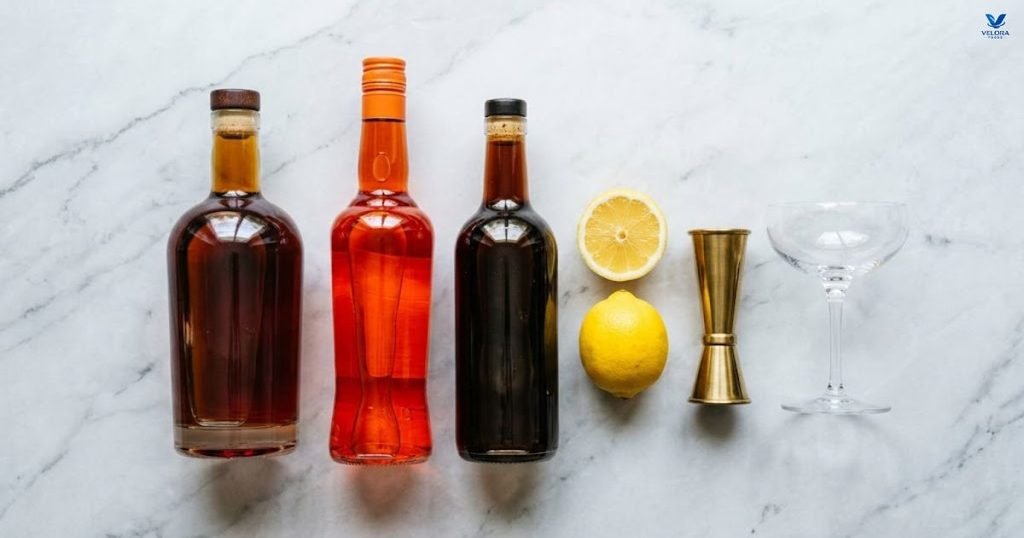
With only four ingredients, quality matters. There is nowhere for a weak ingredient to hide, so it pays to choose each one with care.
Bourbon
Pick a bourbon you would happily sip neat. Ross has recommended a slightly higher-proof bottle in the 43 to 46 percent ABV range (86 to 92 proof), because it stands up to the amaro and lemon without disappearing. Elijah Craig Small Batch is a commonly suggested choice, and recipe writers also mention Four Roses, Knob Creek, Maker’s Mark, and Evan Williams. A rye-heavy bourbon adds spice, while a wheated bourbon makes a softer, rounder drink.
Aperol
Aperol is a bright orange Italian aperitivo that is lighter in alcohol and sweeter than Campari. It provides color, citrus, and a gentle bitter edge. Do not skip it: Aperol is what makes a Paper Plane taste like a Paper Plane instead of a generic bourbon sour.
Amaro Nonino Quintessentia
Amaro Nonino is a grappa-based Italian amaro known for notes of orange peel, caramel, and warm spice. It is usually the most expensive and hardest-to-find ingredient in the drink, but one bottle makes many cocktails. If you cannot find it, see the substitution table later in this guide.
Fresh Lemon Juice
Squeeze it right before you mix. Bottled lemon juice tastes flat and sometimes metallic, and it throws off the balance in a drink that has no sugar syrup to cover mistakes. One medium lemon usually gives you enough juice for one or two cocktails.
Ice and Glassware
Use cold, hard ice for shaking, because small wet ice melts quickly and over-dilutes the drink. Chill your coupe in the freezer for 10 to 15 minutes before pouring, or fill it with ice water while you shake.
How to Make a Paper Plane (Step-by-Step Recipe)
This is the full Paper Plane drink recipe for one cocktail. It takes about three minutes from start to finish.
Equipment
- Cocktail shaker (Boston or cobbler)
- Jigger or other measuring tool
- Fine-mesh strainer (optional, for a cleaner pour)
- Coupe or cocktail glass
- Citrus peeler for the garnish
Ingredients (1 Cocktail)
- 3/4 oz (22 ml) bourbon
- 3/4 oz (22 ml) Aperol
- 3/4 oz (22 ml) Amaro Nonino
- 3/4 oz (22 ml) freshly squeezed lemon juice
- Ice, for shaking
- Lemon or orange peel, for garnish (optional)
Instructions
- Chill a coupe or cocktail glass in the freezer, or fill it with ice water while you work.
- Measure the bourbon, Aperol, Amaro Nonino, and lemon juice into a shaker. Measure carefully, because equal parts only work when they really are equal.
- Fill the shaker about two-thirds full with ice.
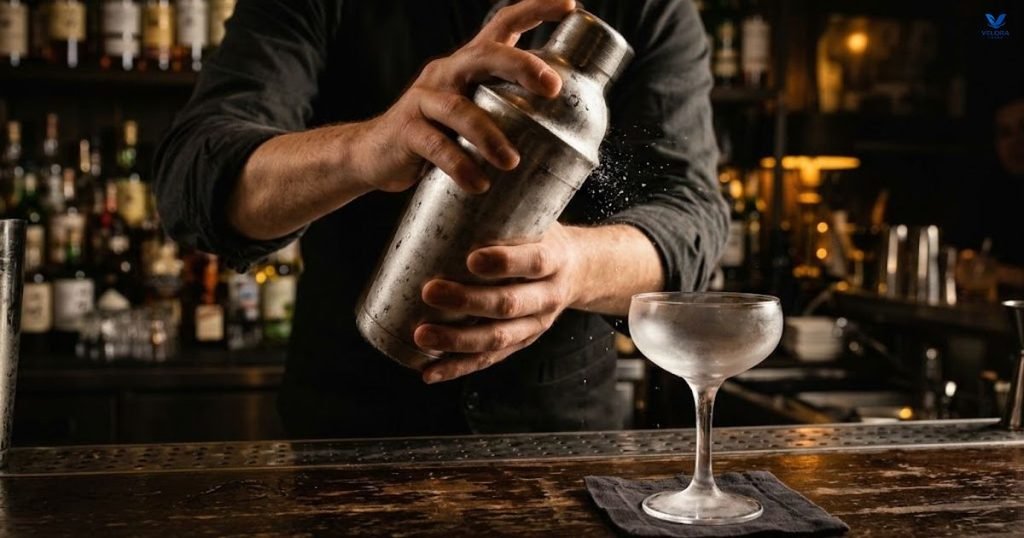
- Seal the shaker and shake hard for 10 to 15 seconds until the outside is frosty and painfully cold. Recipes vary from about 10 to 30 seconds; the goal is chill and dilution, not exhaustion.
- Empty the ice water from your glass and strain the drink in. Double-straining through a fine mesh keeps ice chips out.
- Express a lemon or orange peel over the surface, then drop it in, or perch a small folded paper plane on the rim.
Scaling the Recipe
Because the recipe is ratio-based, scaling is simple. Table 2 shows amounts for one to eight drinks. If you are serving a crowd, read the batching section further down before you mix everything together.
| Drinks | Bourbon | Aperol | Amaro Nonino | Lemon juice |
|---|---|---|---|---|
| 1 | 3/4 oz (22 ml) | 3/4 oz (22 ml) | 3/4 oz (22 ml) | 3/4 oz (22 ml) |
| 2 | 1.5 oz (44 ml) | 1.5 oz (44 ml) | 1.5 oz (44 ml) | 1.5 oz (44 ml) |
| 4 | 3 oz (89 ml) | 3 oz (89 ml) | 3 oz (89 ml) | 3 oz (89 ml) |
| 8 | 6 oz (177 ml) | 6 oz (177 ml) | 6 oz (177 ml) | 6 oz (177 ml) |
| 1 (IBA spec) | 30 ml | 30 ml | 30 ml | 30 ml |
Tips for a Better Paper Plane
Taste and Tweak
If your bourbon is sweet and your lemons are mild, the drink can taste a little soft. Add a few extra drops of lemon. If it tastes too sharp, a barspoon of simple syrup or a slightly smaller squeeze of lemon helps. Adjust in tiny steps, because an equal-parts drink is easy to knock out of balance.
Shake Hard and Use Plenty of Ice
A short, timid shake leaves the drink warm and sharp. A proper shake chills it, adds a little water to soften the alcohol, and gives the surface a light, silky texture. Fill the shaker well and shake until your hands feel the cold.
Serve It Properly Cold
A paper plane is traditionally served up, so it has no ice in the glass to keep it cold. A pre-chilled coupe makes a noticeable difference in the first few sips.
Garnish with Intent
The IBA lists no garnish, but Wikipedia notes (“Paper plane (cocktail),” n.d.) that Difford’s Guide and Esquire both recommend a lemon twist. Express the oils over the drink so the aroma greets you before the first sip. For a playful finish, fold a small square of paper into a dart and balance it on the edge of the glass.
Measure Every Time
Equal parts sound forgiving, but a heavy hand on any one ingredient changes the drink fast. Extra Aperol makes it sweeter, extra amaro makes it heavier, and extra lemon makes it sharp. Use a jigger, not a free pour.
Paper Plane Substitutions That Still Work
Can’t find a bottle? You can still make a good drink. Just remember that every swap changes the flavor and sometimes the color, as Feast and West points out (Feast and West, n.d.). Table 3 lists the most useful substitutions.
| Ingredient | Substitute | What changes |
|---|---|---|
| Bourbon | Rye whiskey | Drier and spicier, with more peppery bite |
| Bourbon | Scotch whisky | Lighter, fruitier, and slightly malty |
| Aperol | Campari | More bitter and a deeper red; use a little less or add a touch of sweetener |
| Amaro Nonino | Amaro Averna | Darker, richer, and a bit sweeter |
| Amaro Nonino | Amaro Montenegro | Lighter and more floral |
| Lemon juice | Orange juice | Sweeter and fruitier; the drink loses its sharp edge |
Paper Plane Variations to Try
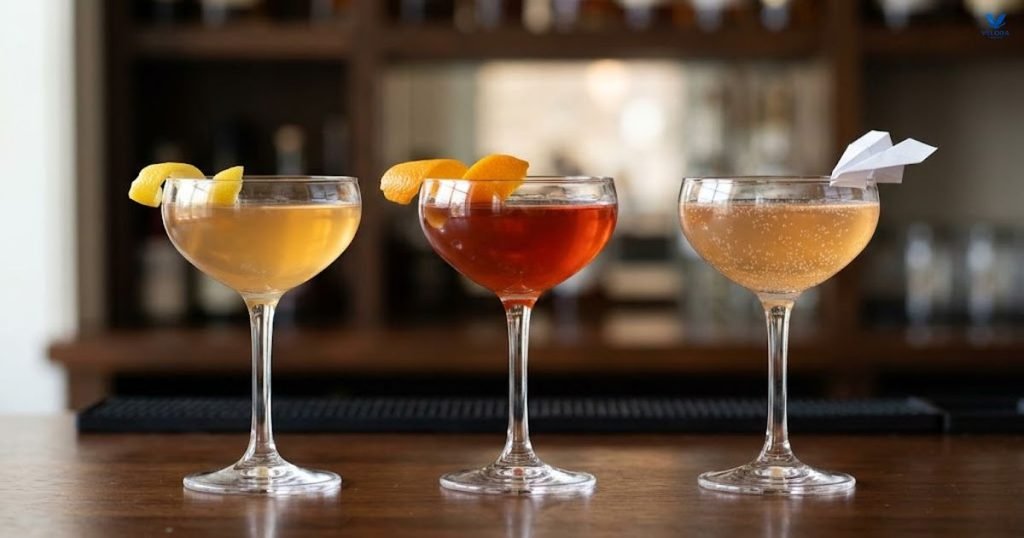
Once you have the classic down, the equal-parts formula makes experimenting easy. Change one thing at a time and you will quickly learn what each ingredient contributes.
The Original Campari Version
Swap Aperol for Campari to taste the drink as it reportedly started. It is bolder, more bitter, and a deeper red. If that is too aggressive, trim the Campari slightly or add a little simple syrup.
The Paper Airplane
A close cousin, the Paper Airplane, uses Buffalo Trace bourbon and Campari while keeping the Amaro Nonino, according to Kindred Cocktails (Kindred Cocktails, n.d.). It is a good option for people who like their cocktails assertively bitter.
The Scotch Paper Plane
The Glenlivet shares its own Paper Plane variation with 12 Year Old Scotch (The Glenlivet, n.d.). Scotch makes the drink fruitier and slightly smoky or malty, depending on the bottle.
Sparkling and Highball Versions
The same source suggests topping the drink with soda for a longer, lighter highball, or with Prosecco for a sparkling version. Both are good ways to stretch a single cocktail across a long summer afternoon.
A Fruit-Forward Twist
You can also experiment with part of the lemon juice replaced by orange, strawberry, or cherry for a fruitier drink. Keep some lemon in the mix so the acidity does not disappear.
| Variation | Main change | Result |
|---|---|---|
| Original Paper Plane | Campari instead of Aperol | Bolder, more bitter, deeper red |
| Paper Airplane | Buffalo Trace and Campari | Assertive, drier, bitter |
| Scotch Paper Plane | Scotch instead of bourbon | Fruitier and malty |
| Sparkling Paper Plane | Topped with Prosecco | Lighter and festive |
| Paper Plane Highball | Topped with soda over ice | Long, refreshing, lower strength per sip |
Paper Plane vs. Last Word vs. Final Ward
Because the Paper Plane is a riff on the Last Word, people often confuse the two. They share a structure but not a flavor. The Last Word is herbal and vegetal thanks to green Chartreuse, while the Paper Plane is bittersweet and orange-forward. The Final Ward, created by bartender Phil Ward, is another well-known relative that swaps in rye whiskey and lemon juice, as described on Wikipedia’s Last Word page (“Last Word (cocktail),” n.d.).
| Cocktail | Base spirit | Liqueurs | Citrus | Flavor |
|---|---|---|---|---|
| Paper Plane | Bourbon | Aperol, Amaro Nonino | Lemon | Bittersweet and orange-forward |
| Last Word | Gin | Green Chartreuse, maraschino | Lime | Herbal and tart |
| Final Ward | Rye whiskey | Green Chartreuse, maraschino | Lemon | Spicy, herbal, and sharp |
How to Batch Paper Plane Cocktails for a Party
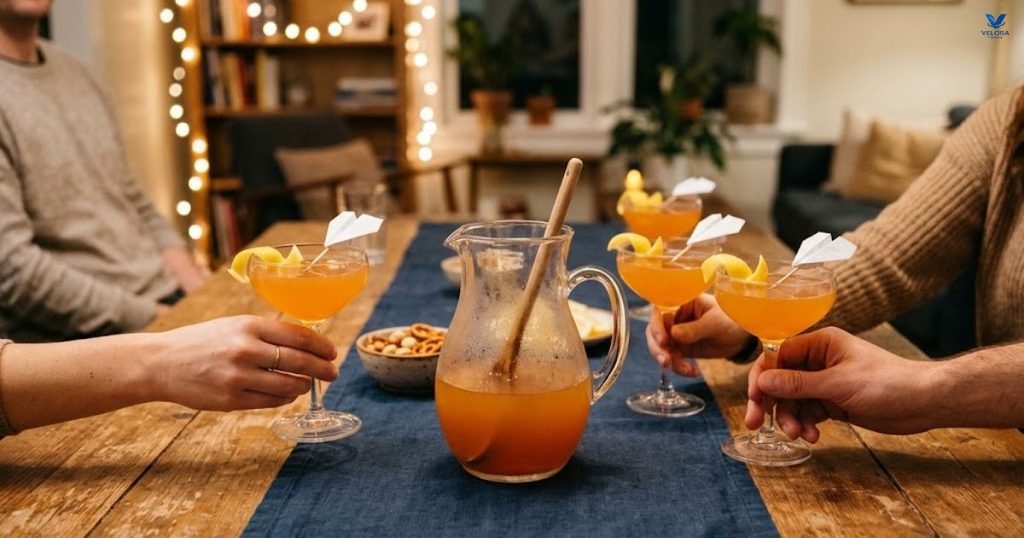
The Paper Plane is a great party drink because the ratio is so easy to multiply. A smart approach, shared by Mix That Drink (Mix That Drink, n.d.), is to batch the spirits and keep the lemon separate so it stays fresh.
- Combine equal parts bourbon, Aperol, and Amaro Nonino in a clean bottle or pitcher. For eight drinks, that is 6 oz (177 ml) of each.
- Seal and refrigerate until guests arrive.
- When someone wants a drink, measure 2.25 oz (about 66 ml) of the spirit mix and 3/4 oz (22 ml) of fresh lemon juice into a shaker with ice.
- Shake hard, strain into a chilled glass, and garnish.
If you mix the lemon in ahead of time, the drink will still be pleasant, but the juice loses brightness within hours. Fresh lemon at the last minute always tastes better.
How Strong Is a Paper Plane? Alcohol, Calories, and Responsible Drinking
The National Institute on Alcohol Abuse and Alcoholism explains that a US standard drink contains about 14 grams of pure alcohol, which is the amount in 1.5 fluid ounces of 40 percent spirits. You can read the full definition on the NIAAA website (National Institute on Alcohol Abuse and Alcoholism [NIAAA], n.d.).
A Paper Plane contains 3 oz of liquid before shaking, but only three of the four ingredients contain alcohol. Using typical bottle strengths of roughly 45 percent for bourbon, 11 percent for Aperol, and 35 percent for Amaro Nonino, the drink works out to about 0.68 fluid ounces of pure alcohol. That is roughly 1.1 US standard drinks, so a single Paper Plane is a little stronger than one standard drink. Check your own bottle labels, because strengths vary.
| Ingredient | Amount | Approx. ABV | Pure alcohol (fl oz) |
|---|---|---|---|
| Bourbon | 0.75 oz | 45% | 0.34 |
| Aperol | 0.75 oz | 11% | 0.08 |
| Amaro Nonino | 0.75 oz | 35% | 0.26 |
| Lemon juice | 0.75 oz | 0% | 0.00 |
| Total | 3.0 oz | 0.68 (about 1.1 standard drinks) |
Calorie estimates vary widely between published recipes, from roughly 120 to just over 200 calories per drink, depending on pour size, brands, and what is counted. If you are watching your intake, you can use our daily caloric needs calculator and daily sugar intake calculator to see how a cocktail fits into your day.
A few common-sense reminders: never drive after drinking, drink water between cocktails (our daily fluid intake calculator can help with hydration goals), do not drink if you are pregnant or taking medication that interacts with alcohol, and know your own limits. This article is for informational purposes and is not medical advice.
Non-Alcoholic Paper Plane (Mocktail Version)
There is no official alcohol-free Paper Plane, but you can build a drink with a similar bittersweet, citrusy personality. Treat the recipe below as a starting point and adjust it to taste.
- 1 oz strong black tea, brewed and fully chilled (it adds tannin and body, similar to whiskey)
- 1 oz fresh orange juice
- 3/4 oz fresh lemon juice
- 1/4 oz honey or simple syrup
- 2 dashes non-alcoholic orange bitters, optional
Shake everything with ice, strain into a chilled coupe, and garnish with an orange twist. It will be lighter and sweeter than the original, so reduce the syrup if you prefer something tarter. For more ideas, browse our collection of drink recipes.
What to Serve With a Paper Plane
The bittersweet, citrusy profile pairs well with salty, rich, and savory foods. Italian-style snacks are a natural fit, and you will find similar flavors in our Mediterranean food recipes.
| Food | Why it works |
|---|---|
| Salted nuts and olives | Salt softens the bitterness and highlights the orange notes |
| Aged cheese such as Parmesan | Nutty richness balances the lemon acidity |
| Prosciutto and cured meats | Salty fat pairs with the bittersweet amaro |
| Citrus or fennel salad | Echoes the bright orange and herbal notes |
| Roast chicken or grilled fish | Light proteins that do not fight the drink |
| Dark chocolate | Bitter and sweet flavors play off each other |
Frequently Asked Questions About the Paper Plane
What is in a Paper Plane cocktail?
A Paper Plane contains equal parts bourbon, Aperol, Amaro Nonino, and fresh lemon juice. It is shaken with ice and strained into a chilled glass.
Who invented the Paper Plane cocktail?
Bartender Sam Ross created it around 2007 to 2008 for The Violet Hour in Chicago. Some accounts also credit Sasha Petraske as a co-creator.
Is the Paper Plane sweet or bitter?
It is both. The bourbon and Aperol bring sweetness, the amaro and Aperol add bitterness, and the lemon supplies acidity. Most people find it balanced, with a bittersweet finish.
Is a Paper Plane shaken or stirred?
Shaken. Any cocktail with citrus juice should be shaken so the ingredients combine properly and the drink gets chilled and aerated.
What bourbon is best for a Paper Plane?
Choose a bourbon you like on its own. Ross has suggested a slightly higher-proof bottle between 43 and 46 percent ABV, which holds up well against the other ingredients.
Can I use Campari instead of Aperol?
Yes. Campari reportedly appeared in the earliest version. It is more bitter, so use slightly less or add a touch of sweetener.
What can I use instead of Amaro Nonino?
Amaro Averna and Amaro Montenegro are the most common substitutes. Each changes the flavor and color, but both make a delicious drink.
How strong is a Paper Plane?
A single drink contains roughly 1.1 US standard drinks, based on typical ingredient strengths. See the alcohol section above for the full breakdown.
Can I make a Paper Plane ahead of time?
You can batch the bourbon, Aperol, and amaro in advance. Add fresh lemon juice and shake to order for the best flavor.
Should a Paper Plane be served on ice?
Traditionally it is served up in a chilled coupe. If you like it long, pour it over a large cube or top it with soda for a highball.
Final Thoughts
The Paper Plane earned its place among modern classics by being simple, balanced, and endlessly adaptable. Equal parts of bourbon, Aperol, Amaro Nonino, and lemon juice, a hard shake, and a cold glass are all you need. Once you have mastered the original, try the Campari version, a Scotch riff, or a sparkling twist, and keep a small stack of paper for the garnish. Drink responsibly, share generously, and enjoy the flight. Looking for more ideas? Explore our healthy recipes and our free nutrition and health calculators.
Medical Note
This article is for general information only and is not medical advice. The Paper Plane contains alcohol and is only for adults of legal drinking age. Do not drink if you are pregnant, breastfeeding, taking medication that interacts with alcohol, or have a health condition (such as liver disease or diabetes) that your doctor has advised you to avoid alcohol for. Drink in moderation, never drive after drinking, and speak to a healthcare professional if you have any concerns.
References
- Difford’s Guide. (n.d.). Last Word. https://www.diffordsguide.com/cocktails/recipe/1133/last-word
- Feast and West. (n.d.). Paper plane cocktail. https://feastandwest.com/paper-plane-cocktail/
- The Glenlivet. (n.d.). Paper plane. https://theglenlivet.com/en-gb/whisky-cocktails/paper-plane
- International Bartenders Association. (n.d.). Paper plane. IBA Official Cocktails. https://iba-world.com/paper-plane/
- Kindred Cocktails. (n.d.). Paper airplane. https://kindredcocktails.com/cocktail/paper-airplane
- Last Word (cocktail). (n.d.). In Wikipedia. https://en.wikipedia.org/wiki/Last_Word_(cocktail)
- Love and Lemons. (n.d.). Paper plane cocktail. https://www.loveandlemons.com/paper-plane-cocktail/
- Mix That Drink. (n.d.). Paper plane. https://mixthatdrink.com/paper-plane/
- National Institute on Alcohol Abuse and Alcoholism. (n.d.). What is a standard drink? https://www.niaaa.nih.gov/alcohols-effects-health/what-standard-drink
- Paper plane (cocktail). (n.d.). In Wikipedia. https://en.wikipedia.org/wiki/Paper_plane_(cocktail)
- Simonson, R. (2020, September 30). How the Paper Plane became a modern classic. Punch.